
GHANA’S INDUSTRIALISATION DRIVE AGENDA: CAN POWER SECTOR KEEP UP?
- Derek Okai
- Feb 27
- 3 min read

OVERVIEW
According to reports by Energy Commission (2024) and World Bank (2023), Ghana’s goal of a 24-Hour Economy depends on a reliable power sector, but challenges like infrastructure deficits and financial issues cause frequent outages despite reforms. Reports from Ministry of Energy (2025) and IRENA (2023) suggest that while energy sources have diversified, demand is growing faster than supply, requiring strategic investments and new technologies such as smart grids and decentralized renewables. Achieving this vision needs systemic reforms, improved grid management, and collaboration to deliver consistent, affordable power.

KEY HIGHLIGHTS
GENERATION CAPACITY VS DEMAND GROWTH
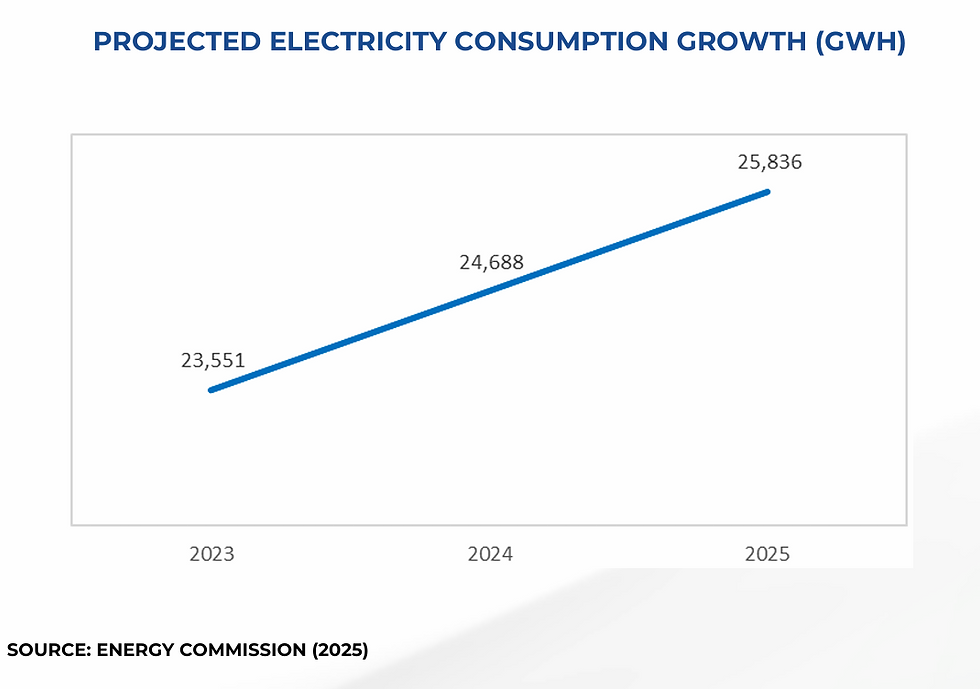
According to IRENA (2023) report, Ghana has made significant progress in expanding its power generation capacity through both renewable and conventional sources. However, demand driven by rapid urbanization and industrial growth continues to outstrip supply.

The International Energy Agency (2024) and Power Africa (2024) noted that supply shortages and load-shedding persist during peak periods, largely due to the intermittency of renewables and aging infrastructure. Accelerated investment, private sector engagement, and smart grid adoption are needed to bridge this capacity gap.
GRID RELIABILITY AND TRANSMISSION CHALLENGES
Data from GRIDCo (2024) reveals that Ghana’s power grid experiences significant transmission losses and inefficiencies, primarily because of outdated infrastructure. These technical losses undermine overall system efficiency and raise operational costs.

As IRENA (2023) highlights, modernizing transmission infrastructure and integrating digital tools for real-time monitoring and automation can drastically improve reliability. Insights from the Africa Energy Outlook (2023) further suggest decentralized power systems offer added resilience, especially for remote and off-grid areas.
POLICY AND INSTITUTIONAL MEASURES
The World Bank (2023) report highlights persistent challenges in Ghana’s power sector, including weak agency coordination and regulatory bottlenecks that continue to constrain efficiency and investment growth.

In line with these observations, the Energy Commission (2024) emphasizes the need for structural reforms and improved regulatory alignment to enhance system performance and sustainability. Building on these recommendations, the Ministry of Energy and Green Transition (2025) has initiated targeted measures such as tariff adjustments, renewable energy expansion, and public–private partnership frameworks to address the earlier challenges and strengthen the sector’s capacity to support Ghana’s 24-Hour Economy agenda
RECOMMENDATIONS
Energy demand analysis reveals that Ghana’s current power capacity is projected to fall short of the increased demand triggered by the 24-hour economy. Without significant expansion of power generation, at least 1,200 MW by 2027, and investments totaling about $10 billion, the power sector is unlikely to fully support the continuous operations envisioned. The current capacity and projected growth suggest the sector may struggle to keep up if these investments are not realized.

Additional scholarly and government reports agree that the power sector’s capacity is not yet sufficient for a 24-hour economy, and the recommendations aim toward capacity expansion, grid modernization, and diversification of energy sources. These measures, if successfully implemented, could provide the necessary support, but without such efforts, the sector will likely face significant challenges sustaining the policy.
CONCLUSION
Given the current generation profile and projected demand growth, Ghana’s power sector is not yet positioned to fully support a 24-Hour Economy. Expanding capacity, upgrading transmission systems, and deepening energy diversification are urgent priorities. If these measures are pursued with consistency and coordination, Ghana can create a resilient power framework capable of sustaining its economic transformation. Without such reforms, however, the risk of recurring outages and instability will remain as the country transitions toward continuous economic activity.


Comments